Operations system for home-appliance sales, rental and maintenance
Jake Tae-moon Jo · Engineering lead · https://jake-jo-portfolio.vercel.app/en/work/field-service-ops/
Built an office web app, a technician app and a customer portal; real use began 123 days after the first commit, and 26 days later the data from the client's old management program was moved into production.
- office, technician, customer
- 3 areas in live use
- first commit to real use
- 123 days
- to load old data into production
- About 8 min
- automated tests, all passing in CI
- 1,263
Results
Real use began 123 days after the first commit, and 26 days later the old management program's data was moved into production.
- Every change request from the client was shipped within 24 hours.
- Built an office web app, a technician app (PWA) and a customer portal in 3 languages, and all three are in live use. One domain and one app serve the three areas, each with its own sign-in.
4 more results
- On Sep 25 the test data was cleared from the production database and real use started from zero, 123 days after the first commit.
- On Oct 21 the customer, contract, equipment, per-appliance consumable and payment history moved over from the old management program. The run had 0 pre-check errors across 7 files and took about 8 minutes, with no customer notifications during it.
- Built 13 PDF templates that carry 2 languages side by side (5 contract variants, receipt, work confirmation, delivery note, scheduled inspection sheet and more) to replace 9 paper forms. Wrote 4 manuals (office, technician, customer, catalog upload) in 2 languages, with screenshots captured automatically from a seed database.
- All 1,263 automated tests passed in the Nov 6 CI run.
Project facts
- Period
- May – Nov 2026
- Role
- Only human on the build team; designed and ran the AI agent team
- Team
- Me plus an 11-role AI agent team
- Platforms
- Office web app, technician app (PWA), customer portal (3 languages)
- Context
- A company in Vietnam that sells, rents out and maintains home appliances, running an old management program with one row per appliance
From first commit to replacing the old program
The client answered all 50 scoping questions in a day; real use began 123 days after the first commit, and the old management program's data was moved into production 26 days later.
- first commit to real use
- 123 days
- real use to the old program's data in production
- 26 days
- Bootstrap
Agent team and build setup carried over from an earlier project; spec and client questions written
- Scope fixed by the client's answers
All 50 questions, each with options and a recommended default, answered
1 more
- Auto-deploy to an in-country VPS begins
The client chose in-country hosting
8 more
- Separate sign-in for office, technicians, customers
Security review fixes on Jun 2
- Client change requests
Requests #1–#4 shipped (12 PRs), then a four-step bulk equipment registration added
- Equipment code rule settled
Per-model sequence, issued by the server only
- Live SMS sending
- Client domain connected
- Migration screen
Two steps: check (no save), then commit
- Real use begins
Test data cleared from the production database; started from zero
- Old program's data loaded into production
7 files, 0 check errors, about 8 minutes, no customer notifications during the run
Screens
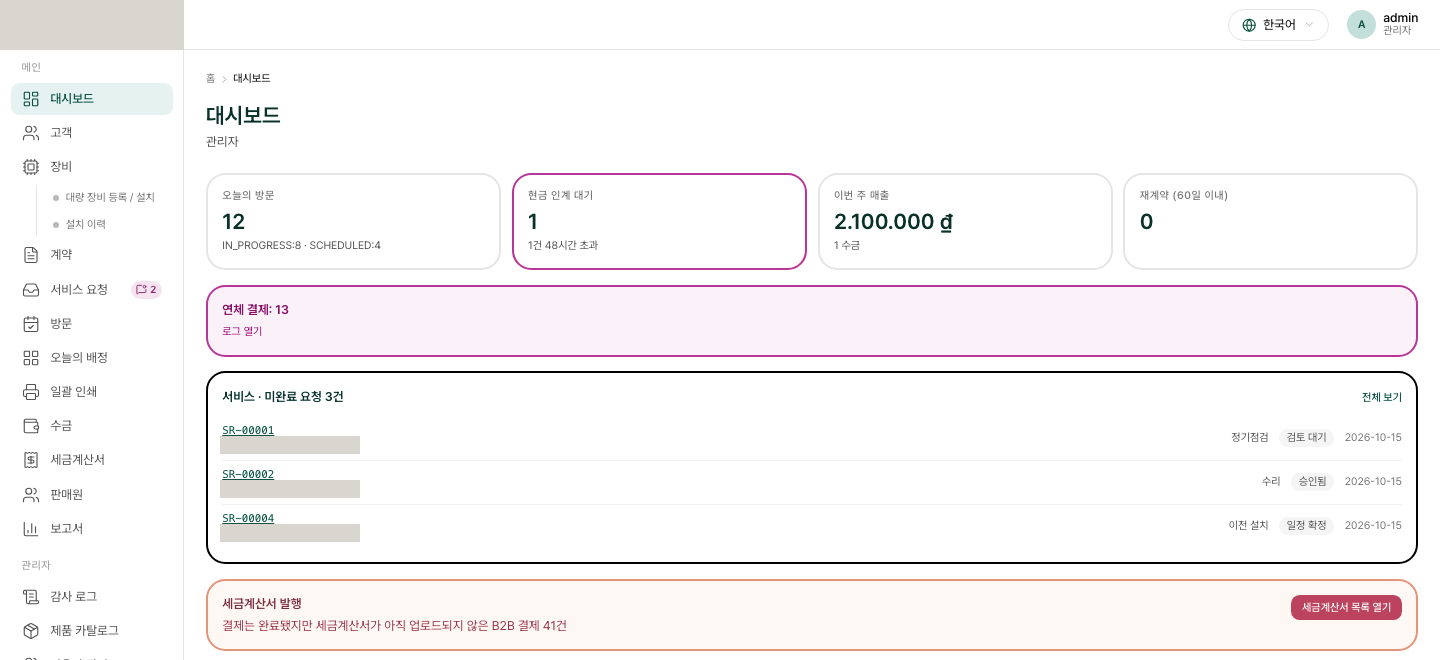
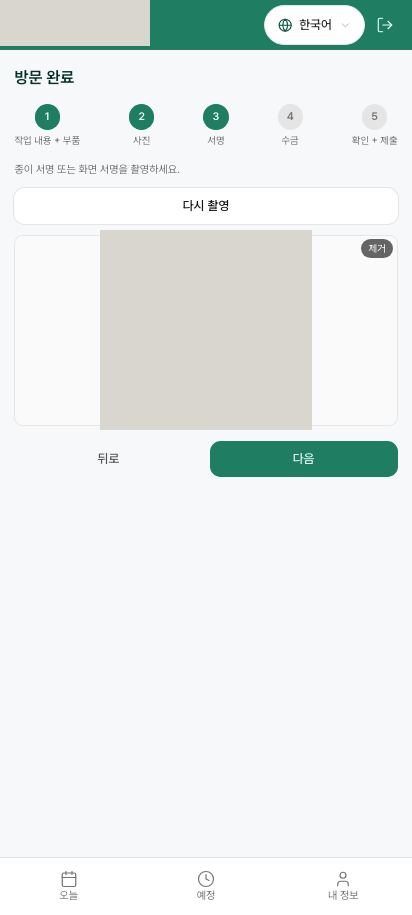
Technician app "Today's visits" (Korean UI)
Each visit card shows service type, date and time, and the documents that need a signature. Seed data; customer names, customer codes, models and logo masked, colours shifted.
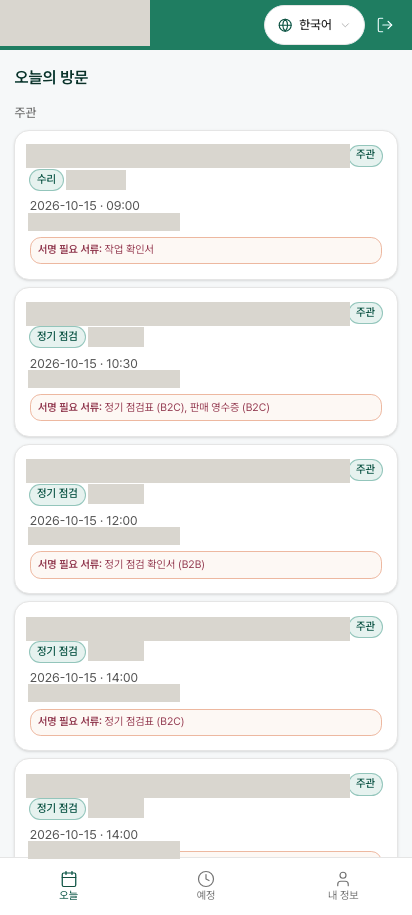
Visit completion, step 3 of 5 (signature) in Korean UI
The screen uploads a photo of the paper signature. Photo and logo masked.
Problem and context
The job was to replace an old program built around single appliances with a system built around the customer, shared by the office, the technicians and the customers themselves.
The client is a company in Vietnam that sells and rents out home appliances and maintains them on a schedule. An appliance starts with a sale or rental contract, and a technician installs it. After that, scheduled visits at a set interval replace consumables and run inspections. On-demand service such as repairs, relocations and paid parts comes in between, and payment arrives as cash on a visit, a bank transfer, or a tax invoice for business customers. When a rental ends, ownership passes to the customer, who can continue on a maintenance contract.
3 more paragraphs
The client ran all this on an old dBase-format management program. The old program kept one row per appliance. A business site with several appliances meant finding, editing and printing the same customer once per appliance. Visit confirmations were also entered appliance by appliance, and consumable due dates were worked out by hand. The goal was: look up a customer once, see everything, update it once.
Head-office staff (three roles: admin, manager, staff), field technicians and customers all handle the same appliances. On the customer side there is one contract owner and several operating contacts. Customers include households and companies with several sites, which called for a three-level hierarchy: customer > site > appliance.
The constraints were clear. The client chose to keep its data on servers inside the country. Technicians had to record work, photos, signatures and payments even where there is no signal, such as an underground car park. The screens had to come in 3 languages, notifications had to go out in each recipient's language, and documents such as contracts and receipts were agreed with the client to carry 2 languages side by side. The history built up in the old program had to move to the new system as well.
The life of one appliance
From contract to the end of the rental, one appliance cycles through scheduled visits and payments, passing between the office, the technicians and the customer.
- Sale or rental contractPerson
Customer > site > appliance; homes and businesses
- InstallationPerson
Installation history stays with the appliance
- Next due dateSystem
Last service date + cycle; an email to the main contact within 14 days
- Scheduled visitPerson
Office picks from the top-3 suggestions; SMS the day before; five-step completion in the app
- On-demand servicePerson
Portal request: free types go straight to a visit, paid ones to office review
- PaymentPerson
Cash on visit, transfer or tax invoice; technician cash tracked until handed to the office
- End of rentalSystem
Ownership passes to the customer; renewed as a maintenance contract
Loops back
- ↺ ⑥ Payment → ③ Next due date: next cycle
My role
I did the planning, designing the questions with their options and recommended defaults, and the client set the scope by answering them. I also ran the agent team.
The agent team has 11 roles: orchestrator, designer, TDD guide, frontend, backend, reviewer, API docs, QA, manuals, git flow and DevOps. The pipeline runs: start a branch → design → failing tests first → implement → tests pass → review and API docs → QA → manuals → PR. The team, the build setup and the rules came over from an earlier project (the construction PMIS); the domain code is new. I am the only git author, and 213 of the 254 commits (84%) carry an AI co-author trailer, or 213 of 227 (94%) leaving out merge commits.
2 more paragraphs
The scope came from questions. On day one (May 25) I wrote 50 questions for the client, each with options, a recommended default, and what stays blocked until it is answered. The client answered all 50 the next day; with questions added later there are 57 now. Seven of the client's answers were major changes against the recommendation (a site level in the hierarchy, several technicians per visit, a preferred technician per customer, tax invoices for every business customer, and others). The decision card numbers (C.3 and so on) are the numbers in that question document. The project keeps no numbered decision register; decisions live in that question document, in the decision tables of the design documents, in commit messages and in the project rules file.
I opened all 142 PRs and merged 139.
Who decided what
The client set the scope by answering the questions, one person designed the questions, and code changes were deployed only when CI was green.
Client
- Answered all 50 questions in a day (May 26); 57 now
- 7 major choices that differ from the recommended default (site hierarchy, several technicians per visit, …)
- In-country hosting (H.1), a PWA for technicians (C.3) and full-history migration (J.1) were the client's picks
- Confirmed operating rules four times (May 26 and 28, Sep 25, Oct 20)
Me
- Every question with options, a recommended default and what it blocks
- Ran an 11-role agent team carried over from an earlier project; 213 of 254 commits carry the AI co-author mark
Gates
- CI on every PR and push to main: migrations, type check, tests, build
- Image build, deploy and health check only after CI is green
- Production purges and migrations need a typed confirmation, a fresh dump and one transaction
System architecture
System architecture
The three areas share one domain and one app but sign in separately, and even the old program's data came in through the same migration screen the staff use.
Click a node, or Tab to it and press Enter, to highlight its note. Dashed boxes are external systems.
- Office web → Reverse proxy
- Technician app → Reverse proxy: HTTPS
- Customer portal → Reverse proxy
- Reverse proxy → App server
- App server → PostgreSQL 16
- Scheduled jobs → App server: /api/cron
- App server → SMS provider
- App server → Email provider
- Legacy program → Office web: workbook
- CI · deploy → App server: deploy
Node notes
- Customers, sites and contacts; contracts (new, amend, renew, annex); equipment (single and bulk registration); visits (calendar, unassigned, batch printing); service requests, payments, tax invoices, reports and admin screens. Tax invoices are PDFs made elsewhere and uploaded by staff (client answer D.1).
- A mobile-first PWA: today, upcoming, visit detail and a five-step completion. Customer phone numbers are hidden; there is only a "call head office" button. With no connection, or if it drops mid-send, the completion is put in an IndexedDB queue.
- Equipment, visit history, payments, tax invoices, service requests (with a message thread) and contacts. One contract owner and several operating contacts each have their own account.
- The dBase-format management program the client used (one row per appliance). The converter never writes to the database: it produces the migration workbook and feeds it through the office app's check-then-commit path. Re-uploading skips whatever is already in.
- Caddy 2 attaches Let's Encrypt certificates automatically and serves all three areas on one domain. Each area uses its own JWT.
- On every PR and push to main it runs migrations, the type check, tests and the build; when green it builds an image, deploys over SSH and runs a health check.
- Timers hold the cash-handover warning, overdue reminders, consumable due dates, rental renewal and completion, day-before visit notice, monthly billing and a nightly backup. Every run writes a CRON_RUN audit row.
- Pages, API and middleware are one Next.js app. The three areas use separate JWT audiences, cookies and session stores, so one browser can be signed in to all three at once. Contracts, visits, payments and service requests move through pure-function transition tables, and every update pins the previous state in the WHERE clause to stop concurrent edits.
- Only urgent notices, such as the day-before visit reminder, go by SMS. Development uses a mock adapter.
- PostgreSQL 16 with Prisma 7. Appliances are never deleted; only their status changes (replaced, relocated, deactivated, terminated).
- All other notices go by email, in the recipient's language (the contract owner or the main operating contact).
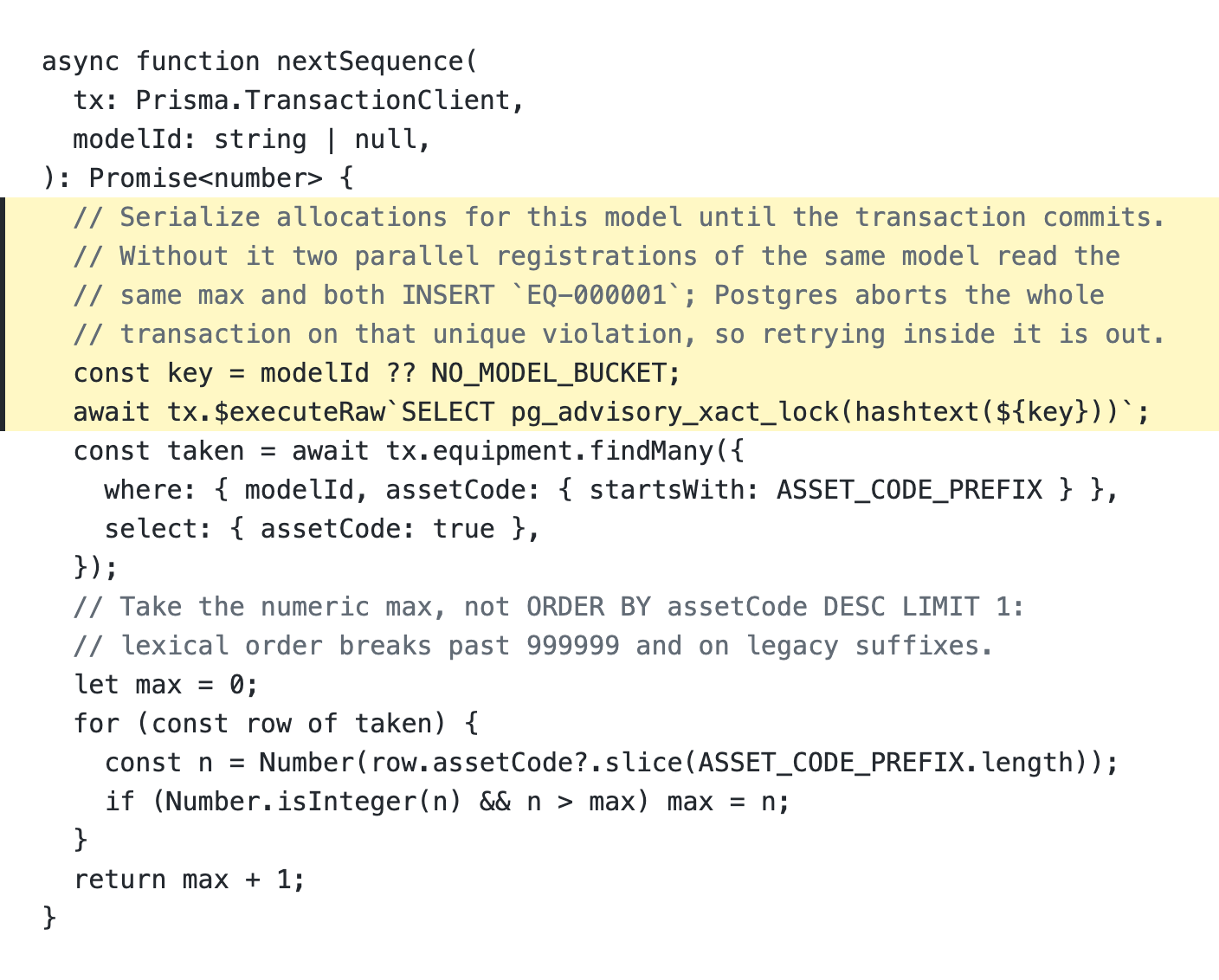
src/lib/equipment/asset-code.ts · A per-model lock keeps concurrent registrations of the same model from taking the same number, and the next number comes from the largest code compared as a number. (comments condensed from the source; prefix changed)
1 code excerpt
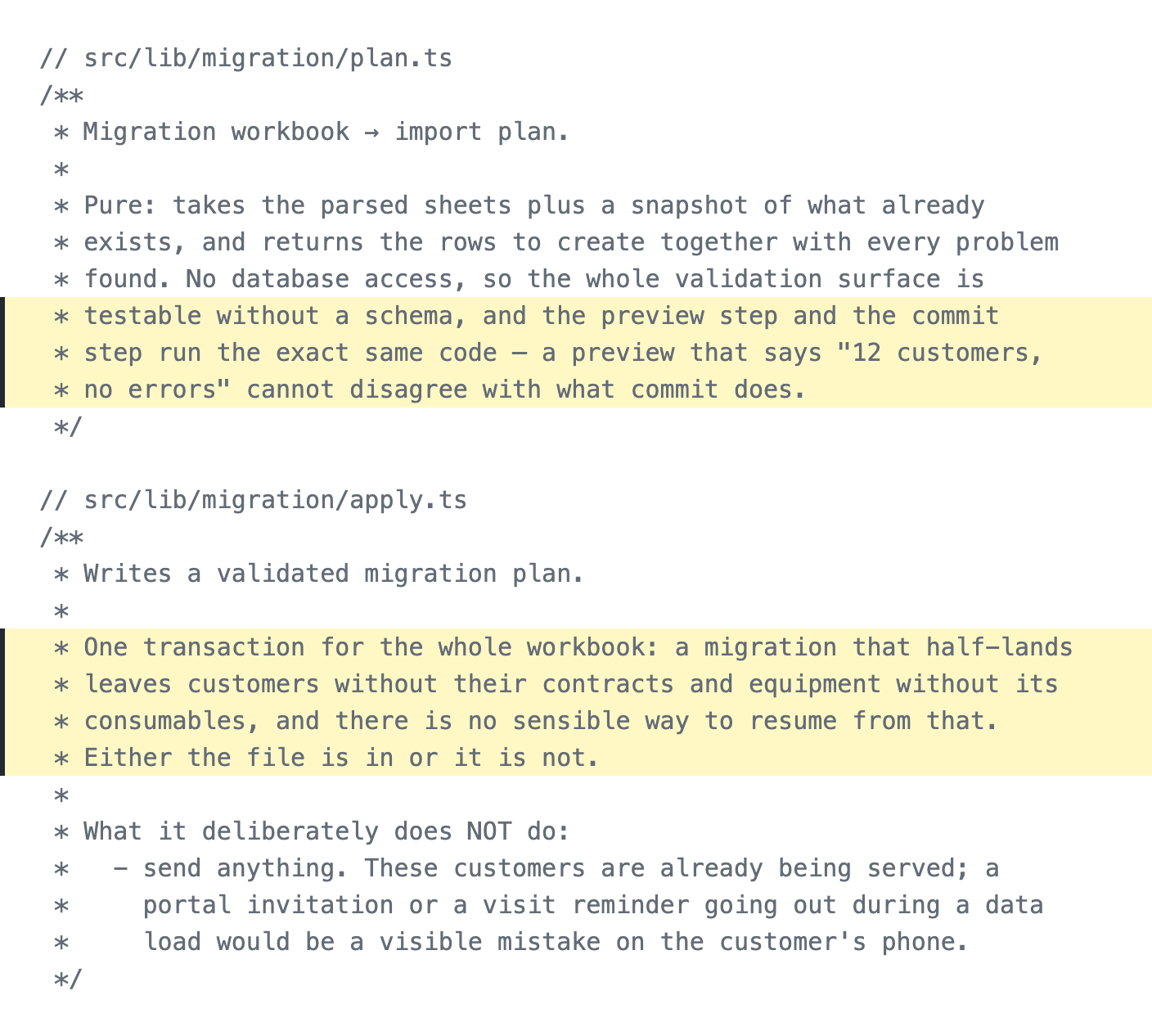
src/lib/migration/{plan,apply}.ts · The validation plan is a pure function with no database access, so preview and commit run the same code, and applying a workbook is one transaction. (the headers of the two modules)
Key decisions
Of the five decisions, four (technician screen, technician assignment, where the data is kept, migration scope) were set by the client answering my questions, and all five are written up with their options and costs.
A PWA for technicians, with an offline queueC.3Client sideDecision The client chose the PWA (C.3) and, for offline, "online first, queue later" (C.4).Result If the device is offline when a completion is submitted, or the connection drops while sending, the app puts the completion in the queue and returns to the screen.
- Problem
- Technicians have to record work, photos, signatures and payments even where there is no signal, such as an underground car park.
- Options considered
- Decision
- The client chose the PWA (C.3) and, for offline, "online first, queue later" (C.4). In practice the offline queue went in anyway, in the last phase of the v1 scope. Pending work is stored in IndexedDB, the service worker is hand-written, and an offline badge shows on screen. Completing a visit takes five steps: work and parts → photos → signature → payment → confirm. Following the client's answer (E.1), the signature is a photo of a signed paper form.
- Result
- If the device is offline when a completion is submitted, or the connection drops while sending, the app puts the completion in the queue and returns to the screen.
- Cost & remaining risk
- As the question stated, photos, signatures and offline handling may be less smooth than in a native app. Maps and route optimization were deferred (C.5).
Technician assignment: the system suggests, the office confirms with one clickC.1Client sideDecision The client chose suggest-and-confirm and asked for a "preferred technician" field per customer (C.2).Result The assignment screen shows the top 3 by score, and the office confirms the lead and assisting technicians.
- Problem
- The office was choosing by hand which technician to send on each visit.
- Options considered
- Decision
- The client chose suggest-and-confirm and asked for a "preferred technician" field per customer (C.2). A visit has one lead technician and any number of assisting technicians (K.3). Only the lead can complete, collect the signature and take payment; assistants add photos and notes only. The score is +100 for the preferred technician, +30 for a matching area and −5 for each visit already booked that day, and an admin screen adjusts the weights.
- Result
- The assignment screen shows the top 3 by score, and the office confirms the lead and assisting technicians. Confirming moves the visit from "suggested" to "scheduled".
- Cost & remaining risk
- Area only adds to a technician's score as a preference (client answer C.2). There is no map-based routing; the map screen is only a placeholder (C.5).
Data stays in the country: a self-hosted local VPSH.1Client sideDecision The client chose in-country storage.Result Merging to main builds an image only when CI is green, then deploys it over SSH and runs a health check.
- Problem
- The first plan was a managed cloud. Where the data had to live decided how it would be hosted.
- Options considered
- Decision
- The client chose in-country storage. On a local VPS, Docker Compose runs Caddy (automatic TLS), the app and PostgreSQL 16, and systemd timers hold the scheduled jobs and the nightly backup.
- Result
- Merging to main builds an image only when CI is green, then deploys it over SSH and runs a health check. One domain serves all three areas.
- Cost & remaining risk
- The servers, certificates, scheduled jobs and backups that a managed cloud would look after have to be run in-house.
Equipment codes: three rules, ending at a per-model sequence issued only by the serverA.3.1Decision A fixed prefix plus 6 digits, with the sequence counted separately for each model.Result On Sep 7 a migration re-issued the codes of existing appliances under the new rule.
- Problem
- Appliances come in through several paths, such as single and bulk registration. Codes could not collide, even when the same model was registered from several paths at once.
- Options considered
- Decision
- A fixed prefix plus 6 digits, with the sequence counted separately for each model. What is unique is the (model, code) pair. A code cannot be edited or reused, and only the server issues codes, on every registration path. The bulk-registration design had an "automatic or manual entry" choice; it was dropped, leaving server-issued codes only. So that concurrent registrations of the same model never take the same number, each model gets an advisory lock, and the next number comes from the largest code compared as a number.
- Result
- On Sep 7 a migration re-issued the codes of existing appliances under the new rule. On Nov 2 the serial number field was removed, and appliances are now told apart by equipment code alone.
- Cost & remaining risk
- A code alone does not identify an appliance; it has to be read together with the model. PostgreSQL 16's default unique index treats NULLs as distinct, so it cannot stop duplicates among appliances with no model; a code comment records that the lock keeps those unique.
Migration: full history, check before commit, one workbook formatJ.1Client sideDecision The client chose the full history.Result The Oct 21 production run had 0 pre-check errors across 7 files and took about 8 minutes, and no notifications went to customers during it.
- Problem
- The customer, contract, equipment, consumable and payment history in the old program had to move over. The old data had one row per appliance, so it had to be grouped by customer.
- Options considered
- Decision
- The client chose the full history. The migration screen came first, on Sep 24: a template, an export of current data, and two steps, "check (no save) → commit". The validation plan is a pure function that never touches the database, so preview and commit run the same code, and applying a workbook is one transaction. On Oct 20 the converter for the old program was built not to write to the database at all: it produces the same migration workbook and sends it down that check-and-commit path. Files are split per customer because of an upload size limit, re-uploads skip what is already in, and every corrected value is reported with a count per kind and examples. The switch date was set to Oct 21.
- Result
- The Oct 21 production run had 0 pre-check errors across 7 files and took about 8 minutes, and no notifications went to customers during it. The flow is shown below. Three kinds of item for staff to check (operating contact, contracts without a monthly amount, appliances without consumable-replacement records) are gathered at the top of the customer screen.
- Cost & remaining risk
- The full consumable and inspection history, outstanding balances and accounting records were not moved; they are looked up in the old program.
Switching over from the old program
The old program's data never went straight into the database; it passed the same check-then-commit screen the staff use, and the production run took about 8 minutes with zero check errors.
- Scope decisionPerson
Full history (the default was active customers only); duplicates auto-matched, then reviewed
- Migration screenSystem
Template, export, check then commit; preview and commit share the code; one transaction per workbook
- ConverterSystem
Writes the same workbook, never the DB; split per customer; re-uploads skip what is already in
- RehearsalSystem
Seven files into an empty DB through the real API: applied in 51 seconds, 0 errors
- Production runSystem
Merge, auto-deploy, backup, 7 files checked with 0 errors, about 8 minutes to apply
- Items to checkPerson
Three kinds gathered at the top of the customer screen: operating contact, contracts without a monthly amount, appliances without consumable records
Quality and verification
Stateful records move through state machines, production data jobs sit behind layered safeguards, and all 1,263 automated tests passed in the Nov 6 CI run.
1,263 automated tests (168 Vitest files) all passed in the Nov 6 CI run on main, along with the type check and the build. Per the work log, the count grew from 418 on May 27 to 656 on Jul 10 and 736 on Jul 21. By file there are 95 unit, 41 integration (against the PostgreSQL service in CI) and 32 component test files; that split is a static count of files.
Anything with a status moves through a state machine. Contracts, visits, payments and service requests use pure-function transition tables, and every update pins the previous state in the WHERE clause. If two people change the same record at once, one of them gets an error.
Deleting or loading production data has layered safeguards. It runs only by hand, needs a typed confirmation, takes a pg_dump just before, and runs as one transaction. Seeding is refused on the production database. A migration upload is applied only after everything has been checked and COMMIT is typed.
1 more paragraph
The July bulk-registration work left sub-agent development records. Across 28 tasks, review returned "approved" 17 times and "needs fixes" 3 times (re-reviewed after the fix); of 4 end-of-phase reviews, 1 was conditional and passed after fixes. In the switch of cycles to days, review caught a bug that added months to a day value and made cycles 30 times too long.
One feature, start to finish
This follows one story from a client question to the production run: the switch from the old management program.
1Question and decision — J.1, J.2 (May 26)
The client chose to migrate the full history (the recommended default was active customers only). Duplicates are matched automatically and then reviewed by a person (J.2), and verification is shared between the client's office admin and the development side.
2Real use begins — production data reset (Sep 24–25)
A workflow clears the test data from the production database. It has a typed confirmation, a dump just before, a single transaction, and gives the same result however many times it runs. After a local rehearsal it ran in production on Sep 25.
3Migration screen (Sep 24)
A workbook template, an export of current data, and the two steps check → commit. The same day the screen was narrowed to admins (ADMIN) only.
4Converter for the old program (Oct 20)
The mapping of the old tables was settled by comparing the program's own CSV export against the source rows. A contract debit-day column and "needs checking" warnings were added. The same day the migration rules were confirmed with the client. When grouping appliance rows into customers, companies are matched by name and households by name plus phone or address. Terminated customers move too, and small old amounts are treated as USD, with the amount left blank and a note added.
5Rehearsal (Oct 20)
One catalog file and seven migration files went into an empty database through the real API in about 1 minute in total, 0 errors. Uploading the same files again skipped everything. Assuming a switch on Nov 1, the scheduled jobs were run for that date, confirming 0 overdue items and 0 reminders on switch day.
6Production run (Oct 21)
The PR was merged in the morning, which auto-deployed and added the new column. After a production database backup and an integrity check, the run went export → convert → check 7 files (0 errors) → apply. Applying took about 8 minutes. No notifications reached customers during the run, and no portal accounts were opened automatically.
Retrospective
The equipment-code rule changed three times, and the deploy chain failed often in its first four days.
The equipment-code rule changed three times. It began as a number based on the customer code; on Sep 4 it became model code plus install date plus sequence, unique across the whole table; on Sep 7 it was settled as a per-model sequence. On Nov 2 the serial number field was removed, and appliances are now told apart by equipment code alone.
1 more paragraph
The deploy chain failed most often in its first four days (May 31 to Jun 3). Problems such as CI wait permissions, Docker runtime dependencies and Caddy TLS were fixed one PR at a time.
How I work
This project was also built with a role-based AI agent team. The team and its gates differ from project to project; this one's are under “My role” above. Below is the method as written up while building the EWA platform.
See how I set up and ran the work on the 2026 EWA platformhttps://jake-jo-portfolio.vercel.app/en/process/